The small island nation of Haiti relies heavily on food imports, but with prices soaring, some Haitians are resorting to eating mud.
The cookies made of dirt, butter and salt hold little nutritional value, but manage to keep Haiti's poor alive.
Worldfocus special correspondent Benno Schmidt and producer Ara Ayer report from Haiti, showing how far some people are going to fill their stomachs.
Showing posts with label Weird Stuff. Show all posts
Showing posts with label Weird Stuff. Show all posts
Tuesday, April 26, 2011
Shanghai Auto Show on This Weekend
Auto Shanghai is a biennial international automobile show that alternates with the Beijing Auto Show and dates to its inception in 1985. Auto Shanghai became the first UFI approved Chinese auto show in June 2004.
Held every two years in the neighborhood of Pudong in Shanghai, China, since the 9th show in 2001, the exhibition has taken place at the Shanghai New International Expo Center.
According to the sponsor some 283,000 people visited the auto show this weekend.


Image Source: imaginechina
Held every two years in the neighborhood of Pudong in Shanghai, China, since the 9th show in 2001, the exhibition has taken place at the Shanghai New International Expo Center.
According to the sponsor some 283,000 people visited the auto show this weekend.


Image Source: imaginechina
Monday, April 25, 2011
Einstein - The World's Smallest Horse
Weighing 6-pounds and standing just 14-inches tall, Einstein is touted as the world's smallest horse, who was born April 22, 2010 in Barnstead, New Hampshire.
Einstein's physical proportions are similar to those of a normal-sized foal, and as Rachel Wagner, one of Einstein’s co-owners, who features in the YouTube video at the end of the page, remarks: "He is very perfect looking little boy and not dwarfy looking at all."


Einstein's physical proportions are similar to those of a normal-sized foal, and as Rachel Wagner, one of Einstein’s co-owners, who features in the YouTube video at the end of the page, remarks: "He is very perfect looking little boy and not dwarfy looking at all."


Tuesday, April 19, 2011
Arab Censorship
There are some unusual prohibitions in advertising in the Muslim world.
They are based on the national and religious peculiarities of Islamic countries.
Any advertising including logos that appear in Arabic-speaking countries should be forcibly adapted to the local cultural values and the Arabic language.
In order to achieve these goals, you need to understand what various animals and symbols mean and how different objects can be interpreted according to the Islamic traditions and customs.
For example, dogs are believed to be “filthy animals” that is why you can rarely see puppies in the local ads. There are other traits as well. Fish symbolizes Christianity. A crow is a symbol of death and a chameleon means hypocrisy.
The Crusades left a deep wound in the Arab psychology. Thus any form of a cross is considered to be a violation here. The Red Cross organization in the Muslim world is called Red Crescent.

t is prohibited to demonstrate open eyes in the advertisements in the most conservative Asian countries. Local advertising agencies have to use their imagination when they show people in ads. The most popular ways of showing eyes are pixelation, glasses and “rolled eyes”.


Magazines
Magazines go through hand-censorship. Even their covers are “finalized”. Photoshop and other things including black markers, paper and glue are widely used. Any form of nudity is prohibited. Islamic culture is very conservative. Only the skin on the face, hands and feet can be showed.


Movies and Video Games
A particular attention is paid to movie advertising. Such ads must get a “retouch” in order to comply with the strict cultural expectations. Legs, chest and even shoulders of women and men have to be covered. Even cartoon characters must be dressed.


Brands
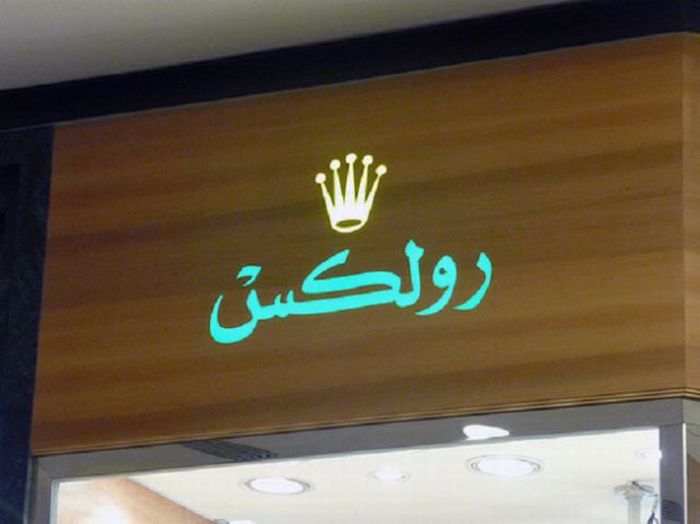
All world-famous brands that are sold in the Asian market have to be adapted to the Arabic script.


Some brands don’t even try to use fonts similar to the original ones when they translate their names into the Arabic language. They sacrifice it for the sake of their brand’s spirit using the simplest classic Arabic fonts.


They are based on the national and religious peculiarities of Islamic countries.
Any advertising including logos that appear in Arabic-speaking countries should be forcibly adapted to the local cultural values and the Arabic language.
In order to achieve these goals, you need to understand what various animals and symbols mean and how different objects can be interpreted according to the Islamic traditions and customs.
For example, dogs are believed to be “filthy animals” that is why you can rarely see puppies in the local ads. There are other traits as well. Fish symbolizes Christianity. A crow is a symbol of death and a chameleon means hypocrisy.
The Crusades left a deep wound in the Arab psychology. Thus any form of a cross is considered to be a violation here. The Red Cross organization in the Muslim world is called Red Crescent.

t is prohibited to demonstrate open eyes in the advertisements in the most conservative Asian countries. Local advertising agencies have to use their imagination when they show people in ads. The most popular ways of showing eyes are pixelation, glasses and “rolled eyes”.


Magazines
Magazines go through hand-censorship. Even their covers are “finalized”. Photoshop and other things including black markers, paper and glue are widely used. Any form of nudity is prohibited. Islamic culture is very conservative. Only the skin on the face, hands and feet can be showed.


Movies and Video Games
A particular attention is paid to movie advertising. Such ads must get a “retouch” in order to comply with the strict cultural expectations. Legs, chest and even shoulders of women and men have to be covered. Even cartoon characters must be dressed.


Brands
All world-famous brands that are sold in the Asian market have to be adapted to the Arabic script.


Some brands don’t even try to use fonts similar to the original ones when they translate their names into the Arabic language. They sacrifice it for the sake of their brand’s spirit using the simplest classic Arabic fonts.




Subscribe to:
Posts (Atom)